
Who Are You When You're Not Performing?


The question sounds simple until you try to answer it.
Who are you when you're not performing?
Not who are you when people are applauding you. Not who are you when the room needs your strength, your polish, your competence, your emotional control, or your ability to make everything look manageable. Not who are you when you are producing, serving, leading, proving, helping, posting, planning, fixing, earning, or making other people comfortable.
Who are you when none of that is required?
For high-functioning people, this can be one of the hardest questions to sit with because performance does not always feel like performance. Sometimes it feels like responsibility. Sometimes it feels like excellence. Sometimes it feels like being the person everybody can count on. Over time, the role becomes so familiar that you stop recognizing it as a role.
That is where Penny lives.
In Dr. Shiela Little’s archetype work, Penny represents the Performance pattern. Her core wound says, “If I impress, I’ll be accepted.” Penny is not trying to be fake. She is trying to stay safe. She has learned that being put together earns approval, that being impressive creates belonging, and that being needed may protect her from being overlooked.
So she performs. Not always loudly. Not always dramatically. Many times, she performs through composure, achievement, helpfulness, emotional restraint, spiritual language, productivity, and the ability to carry more than people realize. The performance may look beautiful from the outside. Inside, it can create distance from the person underneath it.
That is why the question matters. Who are you when you're not performing?
The Question High-Functioning People Often Avoid
High-functioning people are usually more comfortable answering questions about responsibility than identity.
Ask them what needs to be done, and they can give you a list. Ask them who is depending on them, and they can tell you. Ask them where the gaps are, what the plan is, who needs support, what deadline is coming, or what problem needs solving, and they will likely have an answer.
Ask them who they are outside of all that, and the room gets quieter.
Not because they lack depth. Often, it is the opposite. They have spent so much time responding to the needs, expectations, and reactions around them that their inner life has had to wait. They may know how to be excellent in public and still feel unfamiliar to themselves in private.
That kind of distance can be easy to miss because performance often gets rewarded. People praise what the pattern produces. They admire the discipline, the polish, the dependability, the ability to keep moving. They may never ask whether the person being praised is also being drained.
Penny learns to keep going because it works. At least it appears to work. She gets the opportunity, the compliment, the trust, the promotion, the position, the attention, the approval. People see her as capable. What they may not see is how much of her identity has become tied to staying that way.
The danger is not achievement itself. Achievement can be meaningful. The danger is when achievement becomes the only place a person knows how to feel valuable.

How Performance Becomes Identity
Performance becomes identity through repetition.
At first, it may begin as a strategy. A child learns that being helpful gets attention. A teenager learns that achievement creates praise. A young adult learns that composure keeps conflict away. A professional learns that being overprepared makes people respect her. A leader learns that showing need makes others nervous, so she becomes the one who never seems to need much.
One adaptation at a time, the person builds a life around what gets rewarded.
Eventually, she may stop asking whether the role fits. She only asks whether she is performing it well enough.
This is how identity beyond achievement becomes hard to access. The person may genuinely enjoy parts of what she does, but her relationship with it has become complicated. Work is no longer only work. Serving is no longer only serving. Success is no longer only success. These things become evidence. They become proof that she matters, that she is useful, that she deserves to be included, that she is not too much, not behind, not disposable.
That kind of identity is exhausting because it has to be maintained.
If your worth depends on being impressive, you cannot simply have a human day. You cannot be tired without interpreting it as failure. You cannot need support without wondering if you are becoming a burden. You cannot disappoint someone without feeling like your place in their life might be at risk.
Performance turns ordinary moments into emotional tests.
A missed deadline becomes proof that you are slipping. A hard conversation becomes proof that you are not as mature as people thought. A season of low energy becomes proof that you need to get yourself together. A need for help becomes proof that the image is cracking.
That is not identity. That is surveillance from the inside.
What Gets Buried When Image Runs the Operation
When image runs the operation, the person underneath does not disappear. She gets covered.
Her preferences get covered because she has learned to choose what is acceptable. Her needs get covered because she has learned to prioritize what is useful. Her emotions get covered because she has learned which feelings make other people uncomfortable. Her body’s signals get covered because she has learned to keep moving even when she is tired in a way sleep does not fix.
This is where the question “who am I really” can become painful. Not because the answer is absent, but because it has not been given enough room.
Underneath the performance may be a woman who is more sensitive than she allows people to know. There may be someone who wants to create without turning every gift into a responsibility. There may be someone who wants rest without guilt, friendship without proving, leadership without constant composure, and love that does not require her to be impressive first.
There may be grief under there too. Grief for the years spent being admired but not fully known. Grief for the moments when she needed care but offered competence instead. Grief for the version of herself who learned that being easy to applaud was safer than being honest.
The point is not to blame her for performing. Performance likely helped her survive certain rooms, relationships, seasons, and expectations. It may have opened doors. It may have protected her from rejection. It may have given her a sense of agency when other parts of life felt unstable.
But a strategy can be useful and still become too costly.
At some point, the question becomes: Is this performance still protecting me, or is it keeping me from myself?
Meeting the Version of You Before the Role
Love of Self is the right territory for this question because it begins before behavior change.
Many people want to rush into action when they feel uncomfortable. They want a plan, a habit, a rule, or a next step. Those things can help, but identity work asks for a different kind of attention first. It asks you to notice how you relate to yourself when there is nothing to prove.
That is not always easy. The version of you before the role may not come forward with a grand declaration. She may show up in small preferences you have been ignoring. The music you actually like. The pace your body prefers. The conversations that nourish you. The work that feels connected to purpose instead of pressure. The relationships where you do not have to edit yourself into acceptability.
She may also show up through irritation. Sometimes resentment is not proof that you are ungrateful. It may be a signal that a role has outgrown your capacity. Sometimes exhaustion is not proof that you are weak. It may be information that the version of you everyone relies on has been carrying too much without enough support.
Meeting yourself before the role means paying attention to those signals without immediately turning them into judgment.
You may ask: What do I keep doing because people expect it from me? Where do I feel most unlike myself? What part of my life looks successful but feels distant? When do I feel most present, not most impressive? What do I hide because it does not match the version people praise?
These questions are not meant to dismantle your life. They are meant to help you return to it with more honesty.
Why the Answer Is Not a Different Self
The answer to performance is not becoming a completely different person.
That matters because people trapped in performance often swing between two extremes. Either they keep polishing the role, or they fantasize about disappearing from it altogether. They imagine quitting everything, cutting everyone off, starting over, changing their name, moving away, or becoming the kind of person who no longer cares what anyone thinks.
Sometimes life does need a major change. Many times, though, the deeper need is not escape. It is integration.
The goal is not to erase the capable part of you. The capable part may be gifted, disciplined, wise, and necessary. The goal is to stop letting that part be the only part allowed to lead.
You do not have to lose excellence to become more honest. You do not have to abandon ambition to become more aligned. You do not have to stop caring about impact, purpose, or responsibility. The shift is that those things can no longer be purchased with self-abandonment.
The answer is not a different self. It is often an earlier self. A self that existed before performance became the condition for acceptance. A self that had preferences before she learned to please. A self that had emotion before she learned to manage the room. A self that had needs before she learned to be low-maintenance. A self that had dreams before achievement became the proof of worth.
This is why the work can feel like remembering.
Not going backward, but recovering access.
Identity Outside of Work, Achievement, and Approval
Identity outside of work can be especially difficult for Penny because work often gives performance a socially acceptable place to hide. It is easy to call over-functioning “commitment” when there are deadlines involved. It is easy to call emotional suppression “professionalism” when other people are watching. It is easy to call overextension “leadership” when the outcome looks successful.
The same pattern can show up outside of work too. In family, it may look like being the one who handles everything. In friendships, it may look like being available even when you are depleted. In ministry or community leadership, it may look like pouring out while rarely letting anyone pour back into you. In relationships, it may look like being agreeable enough to avoid tension while slowly becoming less known.
So the question expands. Who are you outside of work? Who are you outside of being needed? Who are you outside of the version people compliment? Who are you outside of the role that keeps the peace? Who are you outside of the achievement that made you visible?
These are not small questions. They ask you to separate your identity from the strategies that helped you belong.
The answer does not have to arrive all at once. In fact, it is healthier if it does not. Identity work is often found through repeated moments of telling the truth. Not the dramatic truth you announce to everyone. The internal truth you stop running from.
I do not want this anymore. I need help. I am tired. I miss myself. This looks good, but it does not fit. I want to be known beyond what I can do.
Those truths are not failures. They are openings.

A Starting Place for the Question That Has Been Waiting
If the question “who are you when you're not performing” stirred something in you, do not turn it into another assignment to perfect.
Start with observation.
Notice where you feel most tempted to polish. Notice where you feel most afraid of being misunderstood. Notice who gets the most edited version of you. Notice when you say yes because being disappointing feels dangerous. Notice when you are praised and still feel unseen.
Then notice where you feel relief. The spaces where your shoulders drop. The conversations where you do not have to translate yourself first. The work that feels connected to calling rather than image. The moments where you feel present instead of impressive.
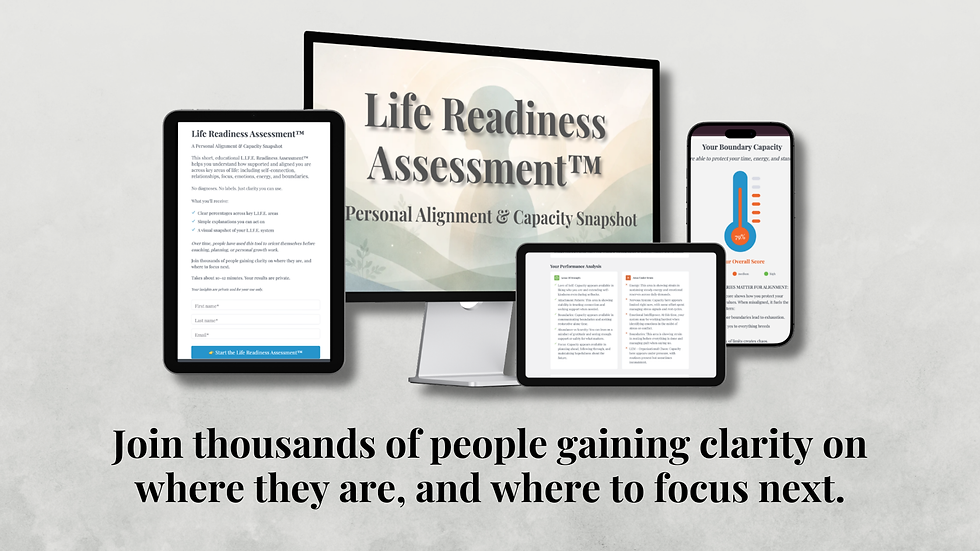
This is where the LIFE Readiness Assessment can support the process. The assessment gives structure to a question that can otherwise feel too big to hold alone. It helps you look at where you are across Love of Self, Interactions with Others, Focus, and Emotions/Energy, so you can begin to see what may be underneath the performance.
It is not a test to pass. It is a mirror for the person who has spent a long time being seen through performance.
Take the LIFE Readiness Assessment here: https://www.lifereadinessquiz.com
You do not have to abandon the capable version of yourself. You simply deserve to know the person underneath her.


Comments