
The Parts You Called Extra

On the bell curve, the kitchen table, and the foundation, you have been calling extra.

By Dr. Shiela Little, LMSW | Shaping Solutions
Dear Reader,
I want to tell you about a conversation I had with myself recently, one of those quiet ones that does not announce itself as important until you are already on the other side of it.
I was thinking about relationships. About what I would actually want in one. And being a creature of frameworks, I drew myself a bell curve. You know the shape, the gentle hill that rises in the middle and tapers off into thin tails on either end. In statistics, that middle is where most of the data lives.
The two tails are where the outliers live. The exceptions. The unusual.
And I told myself something that, on the surface, sounded mature.
If I could find a partner who could carry the 94 percent of me that lives in the middle of the curve, the parts of me that live on each end, three percent on each side, those are mine to manage. That is mine to take care of.
It sounded reasonable. It sounded like the kind of thing emotionally healthy women say. It even sounded like progress, because for years I had been told directly and indirectly that no one person could be everything to me, and I had finally accepted that. The fantasy that one human is supposed to hold every part of you is a fantasy that has cost a lot of women a lot of years.
So this felt like the upgrade. He carries the middle. I carry the ends. Mature. Reasonable. Sorted.
And then something said back to me... and I share this because I absolutely needed to hear it, and I think there is a chance you do too. What if the parts you call the ends are actually you?
The kitchen table
Years ago, before I had any of this language, I sat at my grandmother's kitchen table and tried to explain to the women around me why I wanted to leave the relationship I was in.
On paper, I had everything. The house with the circle drive. The cars. The kids. A man who, by every external measure, was a good partner: present for our children, helpful, providing, someone the world looked at and saw a complete picture. He checked every box that the world tells you to want.
Every box, that is, except the ones that mattered to me.
And I sat at that table and I tried to explain it. The women loved me. They were not unkind. But what they could see was the 94 percent, the visible middle of the bell curve, the part that photographs well, and what they could not see was the other six percent. The part of me that had gone quiet inside the relationship. The part that did not feel seen. The part that did not feel heard. The part where my voice lived.
I did not have language for it then. I just knew that I felt visible on the outside and invisible on the inside. That something in me was slowly going apathetic, and that the apathy was not ingratitude, though it would be called that, and it was not depression in the way the world usually means depression. It was the soul's quiet strike. The part of me that had been ignored long enough that it stopped bothering to ask.
Why I lived in the 94 percent
Now let me tell you what I could not see then.
I had set myself up to live in the 94 percent. And I had done it with such sophistication that I almost did not notice I was doing it.
Because here is the thing about being the talkative girl growing up. The know-it-all. The one with all the questions. The curious one. The one who, depending on the day, was told she was not enough or that she was too much, sometimes both in the same conversation. You learn, very early, that the parts of you that take up the most space are the parts that put you most at risk. So you start filing them away. You learn to be more agreeable in the middle of the curve. You learn to manage the ends of yourself privately, so they do not leak out and get you in trouble.
I had pushed my own ends to the edges to stay accepted. And then I had called that strategy maturity. I had called it self-awareness. I had called it knowing my place.
But the parts of me I exiled. The curiosity, the cleverness, the appetite for understanding people, the strategist who saw three moves ahead, the woman who could feel a room before anyone in it spoke, those were not my edges. They were not my extras.
Those were the parts that made me me. They are the parts that made me a CEO. They are the parts that allow me to design frameworks and read patterns in human systems. They are the parts that make me a creator. I had been calling my 23rd chromosome an inconvenience.
And the relationship I was in could hold the 94 percent of me beautifully. It just could not hold the six percent that was actually who I was. And I had agreed to that arrangement. Quietly. Sophisticatedly. Without ever saying it out loud. I had agreed to be graded on what was visible and to stay silent about what was missing.
That is performance. Not the loud kind. Not the woman-on-stage-in-the-red-dress kind. The quiet kind. The kind that looks like competence. The kind that looks like gratitude. The kind that gets you praised for being so well-adjusted, so reasonable, so easy to love.
Performance is not always about being seen. Sometimes performance is about which parts of you got permission to enter the room.
There is a pattern that lives here. It does not look like performance on the outside. It looks like being easy to love, easy to work with, easy to be around. But underneath it is a quiet calculation... Who do I need to be in this moment to stay acceptable?
I had the geometry right. I was living it wrong.
Here is what took me years to understand.
I had the bell curve right. I just had the math backward.
You have probably heard of the eighty-twenty rule. The principle, in its various forms, says that twenty percent of the inputs produce eighty percent of the results. Twenty percent of the customers. Twenty percent of the effort. Twenty percent of the relationships. The minority of the cause carries the majority of the weight.
The principle holds in business. It holds in time management. It holds in nearly every system that has been studied. And it holds, though almost no one applies it this way, in the architecture of a human being.
I had been treating the 94 percent as the foundation. The agreeable middle. The part everyone can see. I thought if I made the middle strong enough, polished enough, reliable enough, it could compensate for whatever was missing in the six percent on the ends. So I poured my energy into the middle. I optimized the visible. I worked harder at the part that was already working.
It cannot work. The 94 percent can never carry the weight of an unheld six percent. That is not what the middle is for. The middle is the expression. The ends are the foundation.
The reverse, however, is true. And this is the inversion that took me years to see. When the six percent is held, the parts of me where the soul actually lives, the 94 percent becomes almost effortless. The schedules. The relationships. The work. The logistics. The negotiable middle of life stops having to compensate for an unheld self, and it organizes around the foundation it was always meant to rest on.
I had the bell curve right. I was living it wrong. I was trying to use the majority to compensate for the minority, when the minority was the part the majority was supposed to be expressing.
Take care of the six percent, and the 94 percent takes care of itself.
A question for you
I am sharing the bell curve as an analogy. You can use any geometry you want. The eighty-twenty. The middle and the margins. The visible and the hidden. The shape does not matter. What matters is the question underneath it.
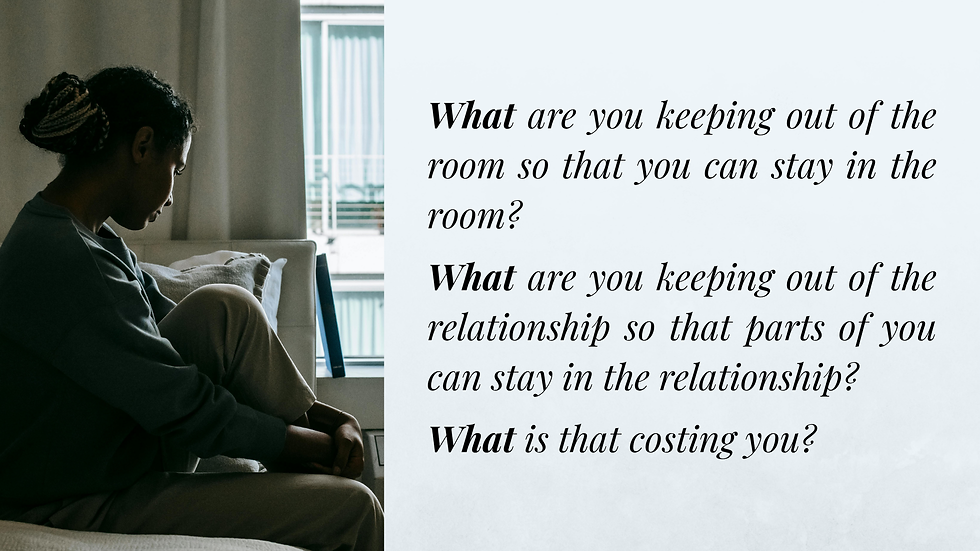
What are you keeping out of the room so that you can stay in the room? What are you keeping out of the relationship so that parts of you can stay in the relationship? And what is that costing you?
Because here is what I want you to know, friend, and I want you to know it clearly: a relationship, or a job, or a friendship, or a community, that can only hold the middle of you is not a small problem. It is a significant one. The middle is the negotiable part. The middle is logistics. Schedules, preferences, who handles the bills, where you spend the holidays. The middle is supposed to flex.
The ends are where you actually live. The ends are where the foundation is.
And when the foundation goes unheld for long enough, the soul does not protest with a grand exit. It does something quieter. It goes apathetic. It stops asking. It starts a slow withdrawal from a life that, on paper, looks like a good one. And the people around you may not see it for years. You may not see it for years.
But you will feel it. You are probably feeling it now, in some room of your life. Not necessarily a romantic one. It might be a family room. It might be a workplace. It might be a friendship that has lasted twenty years and somewhere along the way became a place where only 94 percent of you is welcome.
And here is what I didn't know then
I want to be careful here, because the easy reading of everything I have just told you is: find someone who can hold your six percent. Wait for the right partner, the right friend, the right community to recognize the parts of you that have been hidden, and then bring them out.
That is not what this is.
Because here is what I did not know at my grandmother's kitchen table, and what I am only now beginning to understand. Even if every person in my life had been able to hold my ends, even if the relationship had been able to meet me there, none of it would have mattered until I could hold them myself. Until I could see those parts of me clearly. Until I could give them permission to enter the room.
If I cannot see them, I cannot bring them. And if I cannot bring them, no one is walking through the door carrying them for me.
The work is not finding someone to hold your six percent. The work is bringing it out of the back room of yourself first. The work is naming what you have been calling extra. The work is the slow recognition that the parts you exiled were never the problem, they were the foundation that everything else has been resting on, waiting for you to come back and pick them up.
First the seeing. Then the bringing. Then, and only then, the standing in it with someone who can stand there with you.
That order matters. Reverse it, and you will spend years waiting for someone to read a map you have not yet drawn.
If something here landed
If you are reading this and recognizing yourself somewhere in it: the kitchen table, the soft apathy, the parts of yourself you have called extra for so long that you barely remember they were ever yours, I want you to know two things.
| First, you are not broken for having compressed yourself. You did it for a reason. The compression was an intelligent response to a world that had, at some point, made the full version of you feel unsafe to bring into the room. That is a story your nervous system wrote for very good reasons. You do not need to be ashamed of it. You just need to see it.
Second, the parts you exiled are still in there. They have not gone anywhere. They are waiting for you to come back and pick them up.
If you are looking for somewhere to begin, the LIFE Readiness Assessment is a good first step. It will not tell you what to do. It will give you language. And for most of the women I have walked with through this work, language is the thing that makes the pattern feel workable instead of permanent.
You do not have to change anything yet. But you do need to notice where you are choosing to stay acceptable instead of being fully expressed.
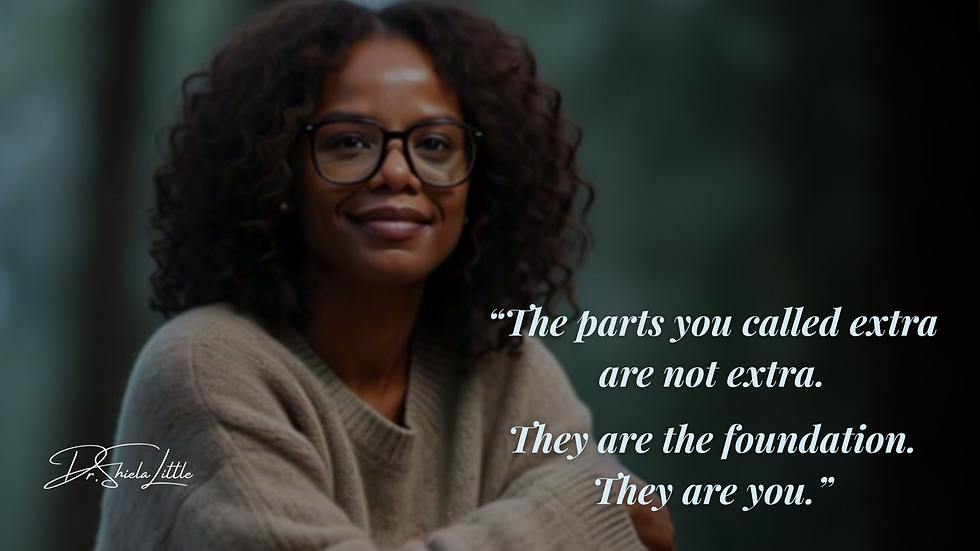
The parts you called extra are not extra.
They are the foundation.
They are you.

With clarity and care,
Dr. Shiela A. Little, PhD, LMSW
Emotional Strategist | Creator of the STOP IT NOW® Methodology
Shaping Solutions LLC
Ready to see your patterns clearly?
Take the LIFE Readiness Assessment at lifereadinessquiz.com

Comments