
When Trying Harder Stops Working: Reading the Signals Underneath High-Functioning Exhaustion


At first, trying harder worked.
You stayed later, gave more, pushed through, figured it out, found another strategy, adjusted your attitude, and kept going. When life demanded more, you became more. When people needed you, you showed up. When pressure increased, you learned how to function under it.
For a while, that may have looked like strength. People could count on you. Things got done. You handled responsibilities that would have overwhelmed someone else. You may have even built a reputation around being capable, dependable, excellent, or composed under pressure.
Then something changed.
The same effort stopped producing the same results. The extra push no longer gave you momentum. The planner did not fix the scattered feeling. The day off did not restore your energy. The motivational talk did not move you into action. You were still doing the things people tell responsible people to do, but inside, it felt like your system was no longer cooperating.
That is a confusing place to be because high-functioning people usually know how to effort their way through a season. So when trying harder isn’t working, they often assume they need more discipline, better habits, a stronger mindset, or a new version of themselves. Dr. Shiela Little’s work offers a different explanation: the issue may not be effort. It may be capacity.
And capacity has signals.
The Exhaustion That Trying Harder Cannot Reach
High-functioning exhaustion does not always announce itself as collapse. Sometimes it looks like answering emails with less patience. It looks like getting things done but needing longer to recover from them. It looks like sitting in the car before walking into the house because you need a few minutes to gather the version of yourself everybody expects.
It can look like being productive while feeling emotionally absent from your own life. You may still meet deadlines, attend meetings, care for family, serve your community, run the business, support the team, and keep up appearances. From the outside, nothing may look urgent. Inside, everything takes more effort than it used to.
This is one reason the Performance pattern can go unnoticed. Penny, the archetype connected to May’s content focus, is not the person who visibly falls apart first. Penny performs wellness. She polishes the outside, hides struggle, and keeps producing because being impressive has felt safer than being honest. Her pattern is not laziness. It is not weakness. It is the body and identity trying to preserve acceptance through achievement.
But achievement is not the same as capacity. Productivity is not the same as alignment. And looking well is not the same as being resourced.
When exhaustion reaches this layer, trying harder can become part of the problem because the strategy being used to solve the depletion is the same strategy that helped create it.
Why Effort Applied to Misalignment Makes the Misalignment Worse
Effort is not the enemy. Effort matters when it is applied to the right problem. The trouble begins when effort is used to override signals instead of read them.
If your body is depleted and you respond with more pressure, you are not building strength. You are increasing strain. If your emotions are overloaded and you respond by demanding more composure, you are not becoming emotionally mature. You are learning to hide distress more efficiently. If your relationships are strained because you keep overgiving, another productivity system will not repair what the pattern is costing you.
This is why effort can stop producing results. It was never designed to solve misalignment. It was designed to execute once capacity, structure, and direction were in place.
Think of it like driving with a dashboard light on. At first, the car still moves, so you keep going. You tell yourself you will check it later. Then another light appears. Then the ride feels different. Then the engine works harder than it should. Pressing the gas harder may get you a little farther, but it does not address the signal.
Many people treat their inner life the same way. Fatigue becomes something to push through. Irritability becomes something to apologize for after the damage is done. Lack of motivation becomes a character judgment. Disorganization becomes another reason to criticize themselves. Isolation becomes “I’m just independent.” Skill gaps become shame.
That is why Dr. Little’s L.E.M.O.N.S.™ model matters. It gives language to the signals underneath the struggle so the person can stop misreading capacity strain as personal failure.
The Six Signals Beneath High-Functioning Exhaustion
L.E.M.O.N.S.™ names the conditions that often appear when a person is functioning but not fully resourced. These are signals of misalignment, not labels to wear. They help you read what is happening beneath the surface of exhaustion, especially when life looks manageable from the outside.
Lack of Energy is more than being tired after a long day. It is the sense that your internal fuel is lower than the life you are trying to carry. Sleep may help, but it does not fully restore you because the issue is not only physical rest. It may be chronic depletion from carrying too much for too long without enough recovery, support, or emotional repair.
Emotional Exhaustion shows up when your emotional tank is overdrawn. You may feel less patient, more reactive, more easily irritated, or more likely to shut down. This can be confusing for people who see themselves as caring, mature, or spiritually grounded. The shift does not mean your character has changed. It may mean your emotional system has been giving without being replenished.
Motivation Deficit is often misunderstood. Many people assume motivation disappears because they are undisciplined, but motivation often drops when the nervous system no longer experiences the goal as safe, meaningful, possible, or properly supported. You may know what needs to be done and still feel unable to begin. That gap is not always a mindset issue. Sometimes it is a capacity issue.
Organizational or Operational Challenges can appear as clutter, missed details, scattered thinking, poor planning, delayed decisions, or difficulty keeping up with responsibilities that used to feel manageable. This is especially frustrating for high-functioning people because they are used to relying on competence. When the system gets overloaded, even capable people can start dropping things.
Necessary Support Absence names the cost of trying to carry life without enough help. Support absence is not always about having no people around. You may have people around you and still lack the kind of emotional, practical, spiritual, or strategic support your life actually requires. Being surrounded and being supported are not the same.
Skillset Gaps are the tools that were never fully taught, modeled, practiced, or reinforced. A person can be highly educated, gifted, responsible, and successful while still needing stronger tools for boundaries, emotional regulation, communication, stress recovery, conflict, decision-making, or follow-through. A skill gap is not a moral failure. It is a place where support and training can create movement.
Together, these six signals help explain why doing all the right things can still leave you exhausted. The problem may not be that you need to try harder. The problem may be that your current effort is being spent on compensating for signals that need to be named.
Reading Your Own Signal Set Without Judgment
Most people do not read their signals early because they have been trained to judge them first.
When energy drops, they call themselves lazy. When emotions rise, they call themselves dramatic. When motivation fades, they call themselves inconsistent. When life feels disorganized, they call themselves irresponsible. When they need support, they call themselves needy. When they lack a skill, they call themselves behind.
Judgment interrupts information. The moment you turn a signal into an insult, you lose access to what the signal is trying to teach you.
Reading your signal set requires a different posture. Instead of asking, “What is wrong with me?” you begin asking, “What is this showing me about my capacity?” That question does not excuse harmful behavior or remove responsibility. It simply gives responsibility a better starting place.
For example, if stress is starting to show up in your tone, the answer may not be to shame yourself into being nicer. The better starting point may be to notice how long you have been operating without emotional recovery. If you keep losing motivation after a few days, the answer may not be another challenge or stricter routine. The better starting point may be to examine whether the goal is aligned, supported, and realistic for your current capacity.
This is where Love of Self becomes practical. Love of Self is not just affirmation or self-esteem language. It is the ability to approach your own patterns with enough honesty and care that you can actually learn from them. Without that, you only keep cycling between pressure and disappointment.
Why Diagnosis Precedes Action
High-functioning people often skip diagnosis because action feels safer. If they can make a plan, they feel in control. If they can create a schedule, they feel responsible. If they can identify a next step, they do not have to sit with the discomfort of not knowing why their old methods are no longer working.
But action without diagnosis often leads to more exhaustion.
A person with Lack of Energy does not need the same starting point as someone whose strongest signal is Necessary Support Absence. Someone dealing with Emotional Exhaustion may need a different pathway than someone facing Skillset Gaps. A person with Organizational or Operational Challenges may not need more motivation at all. They may need structure that lowers cognitive load.
This is why generic advice falls short. “Be consistent” may sound useful, but consistency requires capacity. “Set better goals” can help, but only if the person has enough regulation and support to pursue them. “Just start” may be appropriate in some cases, but if the nervous system is in a shutdown pattern, force can deepen the resistance.
Dr. Little’s framework begins by naming the signal because the signal shapes the intervention. Once the signal is readable, the next step can be more accurate. That is the difference between pushing harder and working with what is actually happening.
Capacity over productivity means you stop measuring your health only by how much you can produce. You begin paying attention to what production is costing, what your system is communicating, and whether the life you are maintaining is aligned with the person God created you to be.
When Effort Used to Work, But No Longer Does
It can be unsettling to realize that an old strength has become an exhausted strategy. The same drive that helped you survive a hard season may not be able to carry you into a healthier one. The same independence that protected you from disappointment may now be blocking support. The same polish that helped you be taken seriously may now be keeping people from knowing where you need help.
This does not make your old strategy bad. It means the strategy may have reached the end of its usefulness.
Penny’s growth does not begin by attacking the performance. It begins by understanding why the performance felt necessary. Maybe being impressive helped her feel safe. Maybe being needed helped her feel valuable. Maybe staying composed helped her avoid judgment. Maybe producing results helped her avoid the ache of feeling unseen.
Once that pattern is named, she can begin to make choices that are not built entirely around approval. She can ask for support before crisis. She can rest before resentment. She can tell the truth before collapse. She can measure growth by alignment rather than applause.
That is not a lack of ambition. It is a more sustainable foundation for it.
The Clearest Way to Start: Get the Signals Named
When trying harder isn’t working, the next step is not another round of self-criticism. The next step is to get more accurate information.
You need to know which signals are most active. Is this primarily depletion? Emotional overload? Lost motivation? Operational chaos? Missing support? A skill gap? A combination? Without that language, it is easy to keep reaching for the wrong solution.
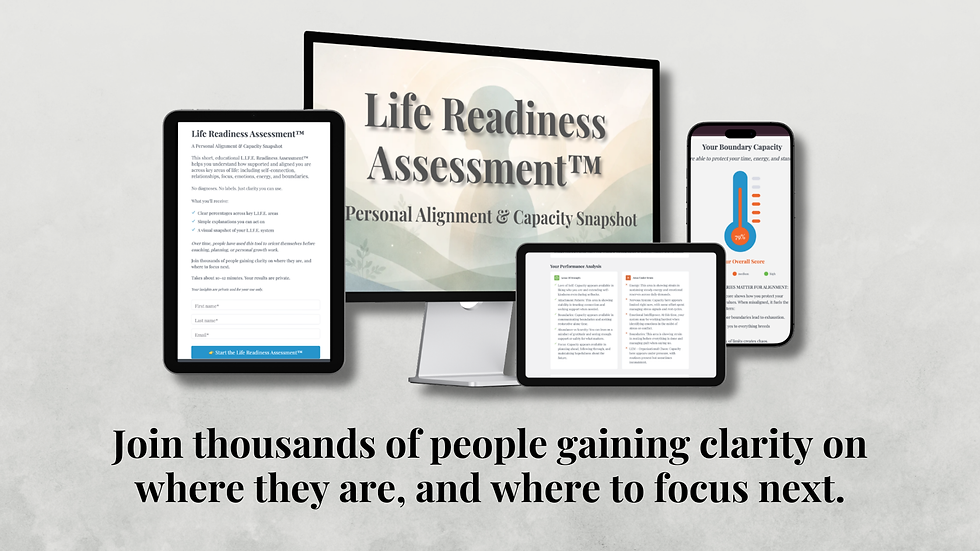
The LIFE Readiness Assessment is designed for that starting point. It helps you look at your current patterns through the L.I.F.E. pillars: Love of Self, Interactions with Others, Focus, and Emotions/Energy. It also helps identify where L.E.M.O.N.S.™ may be showing up so you can stop treating every struggle like a willpower problem.
This assessment is not therapy, and it is not a public performance. It is a private mirror. It gives language to what may have been operating underneath your high-functioning exhaustion, so your next step can begin with recognition instead of pressure.
If you have been doing all the right things and still feel exhausted, it may be time to stop asking for more effort from a system that is asking to be understood.
Take the LIFE Readiness Assessment here: https://www.lifereadinessquiz.com


Comments