
The Difference Between Alignment and Self-Improvement


Most people do not decide to change because they feel loved well.
They decide to change because they are tired of themselves. Tired of repeating the same patterns. Tired of feeling behind. Tired of reacting the same way in relationships, losing focus after a few days of motivation, or showing up for everyone else while feeling disconnected from their own needs. By the time many people begin a self-improvement journey, they are not starting from curiosity. They are starting from disappointment.
That matters because the place you begin from often shapes the kind of growth you build. If your starting point is, “I am a problem,” then even your healing can become harsh. Your goals become another way to prove you are not lazy, not emotional, not too much, not behind, not broken. You may be doing better on the outside while still carrying the same pressure on the inside.
This is why it may be time to stop trying to change yourself and ask a better question: What part of me is trying to come forward, but keeps getting covered by performance, pressure, and old survival patterns?
That question moves you away from self-rejection and toward alignment. It does not let you avoid growth. It gives growth a healthier foundation.
When Self-Improvement Becomes Another Performance
Self-improvement is not automatically unhealthy. Many of us need better tools. We need emotional regulation skills, healthier boundaries, more supportive relationships, stronger focus, and a better way to manage stress. Learning those skills can change the way a person lives.
The problem begins when self-improvement becomes another way to earn acceptance.
This is especially common for the person who has spent years being praised for performing well. She is the dependable one. The productive one. The responsible one. The one who knows how to keep moving even when she is exhausted. People may describe her as strong, disciplined, successful, gifted, organized, or inspiring. Those words sound affirming, but they can also become a trap when she starts believing she is only safe when she is impressive.
That is the pattern Dr. Shiela Little names through Penny, the Performance archetype. Penny’s wound says, “If I impress, I’ll be accepted.” She does not perform because she is fake. She performs because somewhere along the way, being polished became protection. If she could achieve enough, look composed enough, speak well enough, serve enough, or hold everything together long enough, maybe nobody would question her worth.
Self-improvement can easily attach itself to that wound. The journal becomes proof. The morning routine becomes proof. The weight loss, the business growth, the spiritual language, the emotional maturity, the better habits, the polished posts, the packed schedule, all of it can become evidence presented to an invisible jury.
See? I am doing better. See? I am becoming enough. See? I am worth keeping.
That is not freedom. That is performance with better language.
Changing Yourself Is Not the Same as Revealing Yourself
Trying to change yourself often begins with the assumption that the current version of you is unacceptable. You look at your habits, your emotions, your patterns, your delays, your reactions, or your exhaustion and decide they must mean something negative about who you are.
Revealing yourself begins somewhere else. It asks what happened before the pattern became a problem. It asks what your body learned. It asks why performing felt necessary. It asks when achievement became tied to belonging, when overgiving became tied to safety, when silence became easier than honesty, or when being impressive became less painful than being known.
This difference is important because many of the patterns people want to change were once attempts to stay safe, connected, loved, or in control. Overworking may have helped you feel valuable. People-pleasing may have helped you avoid conflict. Perfectionism may have helped you reduce criticism. Emotional shutdown may have helped you survive too much at once. Performing wellness may have helped you avoid the vulnerability of admitting you were not okay.
None of that means those patterns should keep leading your life. It simply means they deserve to be understood before they are interrupted.
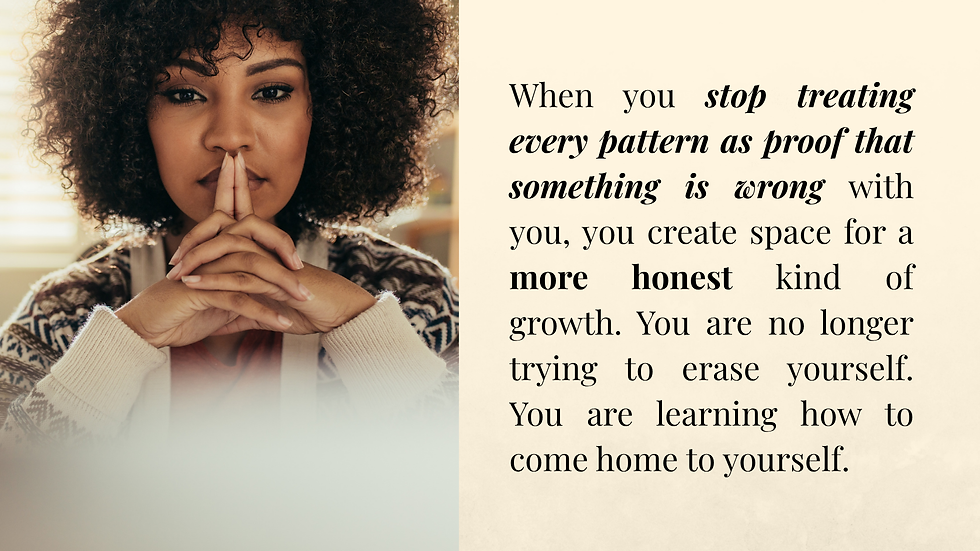
When you stop treating every pattern as proof that something is wrong with you, you create space for a more honest kind of growth. You are no longer trying to erase yourself. You are learning how to come home to yourself.
Alignment vs. Self-Improvement
The difference between alignment vs self-improvement is not that one requires effort and the other does not. Alignment still asks something of you. It may require different choices, different boundaries, different conversations, and different habits. The difference is the motive underneath the work.
Self-improvement often asks, “How do I become better?” Alignment asks, “What kind of life actually fits the person I was created to be?”
Self-improvement can focus on how your life looks. Alignment pays attention to how your life is functioning beneath the surface. You may have the title, the relationship, the family, the ministry, the business, the schedule, the degrees, the income, or the public image, and still feel like your inner life is being squeezed into a shape that no longer fits.
That is why alignment can feel disruptive at first. It may reveal that some of your goals were built around approval. It may show you that some of your relationships only work when you stay overextended. It may help you see that your version of success has been costing you sleep, softness, honesty, or health. Alignment does not always flatter the life you have built. Sometimes it lovingly tells the truth about what that life has been requiring from you.
Self-improvement may help you perform the current life more efficiently. Alignment asks whether that life should still be the one you keep performing.
Why Striving Does Not Always Create Harmony
Many high-functioning people are good at striving. They can push, produce, manage, solve, adjust, and keep moving. They know how to gather information, make a plan, and hold themselves to it. From the outside, striving can look like strength.
The issue is that striving often works even when the person is depleted. That makes it difficult to recognize the cost. You can keep succeeding while your body is asking for recovery. You can keep helping while resentment builds. You can keep smiling while your patience thins. You can keep saying yes while your inner life grows more crowded.
This is why a person can make progress and still not feel at peace with her own life. The progress may be attached to pressure rather than alignment. She may be doing more, but not becoming more honest. She may be achieving more, but not feeling more connected. She may be improving the surface while the deeper pattern remains untouched.
Harmony comes when your choices begin to agree with your capacity, values, identity, and emotional needs. It is not about getting everything perfect. It is about no longer living in constant contradiction with yourself.
A person who is aligned may still have hard days. She may still need support. She may still have patterns to work through. The difference is that she is not using growth as a way to punish herself into acceptability. She is learning to move with herself instead of against herself.
The Hidden Cost of Performing Progress
One of the hardest parts of the Performance pattern is that it often gets rewarded. People praise the very behaviors that are draining you.
They admire how much you can carry. They appreciate how available you are. They benefit from your ability to stay composed. They may even depend on the fact that you rarely ask for much in return. The world often calls this excellence, but sometimes it is exhaustion with a good reputation.
Performing progress can also make it harder to receive support. When everyone believes you are fine, they stop looking closely. When you have trained yourself to present well, you may struggle to admit when life feels heavy. You may even feel embarrassed by your own needs because they do not match the version of you people have come to expect.
So you keep improving. Not because the growth is life-giving, but because stopping would expose the ache underneath.
You sign up for another challenge. You create another plan. You promise yourself that next month will be different. You try to become more disciplined when what you may need is more support. You try to become more positive when what you may need is permission to be honest. You try to become more productive when what you may need is to stop measuring your worth by how much you can produce.
This is where self-acceptance vs self-improvement becomes more than an idea. It becomes a turning point.
Self-acceptance does not mean you excuse every behavior or avoid responsibility. It means you stop using shame as the starting point. You can acknowledge a pattern without making it your identity. You can say, “I keep overgiving,” without deciding, “I am weak.” You can say, “I struggle to ask for help,” without deciding, “I am too much.” You can say, “I perform when I feel unsafe,” without deciding, “I am not genuine.”
That kind of honesty makes change more possible because your nervous system is no longer bracing against your own attack.
Signs You May Be Improving for Approval
You may be improving for approval if your growth still feels like a performance review. You are tracking your progress, but beneath the tracking is a fear that you are falling behind. You are making changes, but the changes are tied to how others will perceive you. You are trying to become a better version of yourself, but the “better” version is mostly more acceptable, more impressive, more agreeable, or more useful.
For some people, this shows up as over-preparing for everything because being caught unprepared feels unbearable. For others, it shows up as hiding emotional pain because they do not want to disrupt the image of being strong. Some people keep choosing goals that sound impressive but do not match their current capacity. Others keep refining their appearance, language, brand, home, work, or schedule while avoiding the deeper question: Do I feel connected to the life I am building?
Another sign is the inability to rest without guilt. If rest only feels allowed after you have earned it through exhaustion, then productivity may have become part of your worth system. If you feel anxious when you are not being useful, visible, needed, or praised, your body may have learned that acceptance is tied to performance.
Again, this is not about shaming the pattern. Penny learned to perform for a reason. The work is to notice when performance has taken the place of presence.
A Better Starting Point: What Needs Alignment?
Instead of asking, “How do I fix myself?” begin with, “Where am I out of alignment?”
That question changes the direction of the work. It moves you from accusation to observation. It helps you look at your life through the L.I.F.E. lens without turning the process into another test you have to pass.
In Love of Self, misalignment may look like being kind to everyone except yourself. You may offer patience, encouragement, and grace outwardly while speaking to yourself with pressure and criticism.
In Interactions with Others, misalignment may show up as resentment, avoidance, over-explaining, or saying yes because disappointment feels too risky.
In Focus, misalignment may look like pursuing goals that no longer match your values or losing motivation because the goal was never truly yours to begin with.
In Emotions and Energy, misalignment may appear as fatigue, irritability, shutdown, emotional flooding, or the sense that you are functioning without feeling fully present in your own life.
When viewed this way, your patterns become information. They are not excuses, and they are not indictments. They are signals that help you understand where support, structure, regulation, or truth may be needed.
That is a much stronger beginning than self-judgment.

You May Not Need a New Self
One of the most exhausting beliefs in personal growth is the idea that the current you must disappear for a better you to arrive. It sounds hopeful at first, but it can create a hidden war inside the person trying to grow.
The goal is not to abandon the self who learned how to survive. The goal is to stop letting survival patterns make every decision.
The goal is not to become someone who never struggles. The goal is to become someone who can tell the truth sooner, recover with more support, and make choices that match who you are becoming.
The goal is not to impress people with your healing. The goal is to live in a way that no longer requires constant performance.
You can be your true self and still be growing. You can reveal your true self and still need practice. You can come home to yourself without having every part of your life figured out. Alignment is not a final destination where nothing feels difficult. It is the ongoing practice of building a life that does not require you to keep abandoning yourself in order to be accepted.
Take the LIFE Readiness Assessment
If this article gave language to something you have been carrying, the next step is not to judge yourself or make another harsh plan. Start with a more honest mirror.
The LIFE Readiness Assessment is designed to help you see where you may be striving for change when your nervous system is asking for alignment. It helps you look at your patterns across Love of Self, Interactions with Others, Focus, and Emotions/Energy so you can begin with recognition instead of self-rejection.
Take the assessment here: https://www.lifereadinessquiz.com
You do not have to become someone else to begin. You may simply need to understand what has been covering the person God created you to be.


Comments